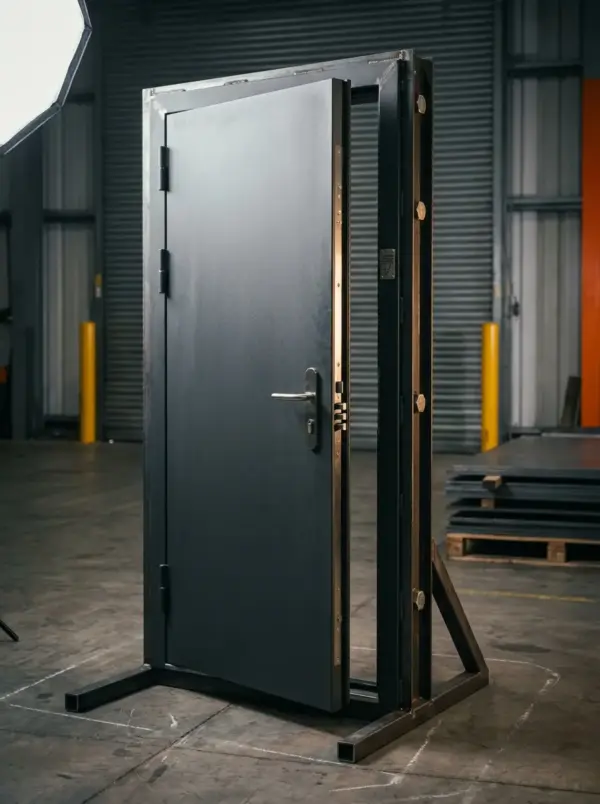
An SR4 door isn’t really a door. It’s an assembly – leaf, frame, hinges, locks, threshold, glazing if it’s there – that has to hold together for 10 minutes against a determined attack with power tools. The LPCB test team tries to break it. If they can’t, it’s certified. If they can, the design goes back to the drawing board.
That sounds simple. It isn’t. There are around 200 individual operations between steel arriving at the loading bay and a certified SR4 door leaving on a truck. Most of them are invisible to the specifier looking at the finished product. This piece walks through what actually happens, in roughly the order it happens.
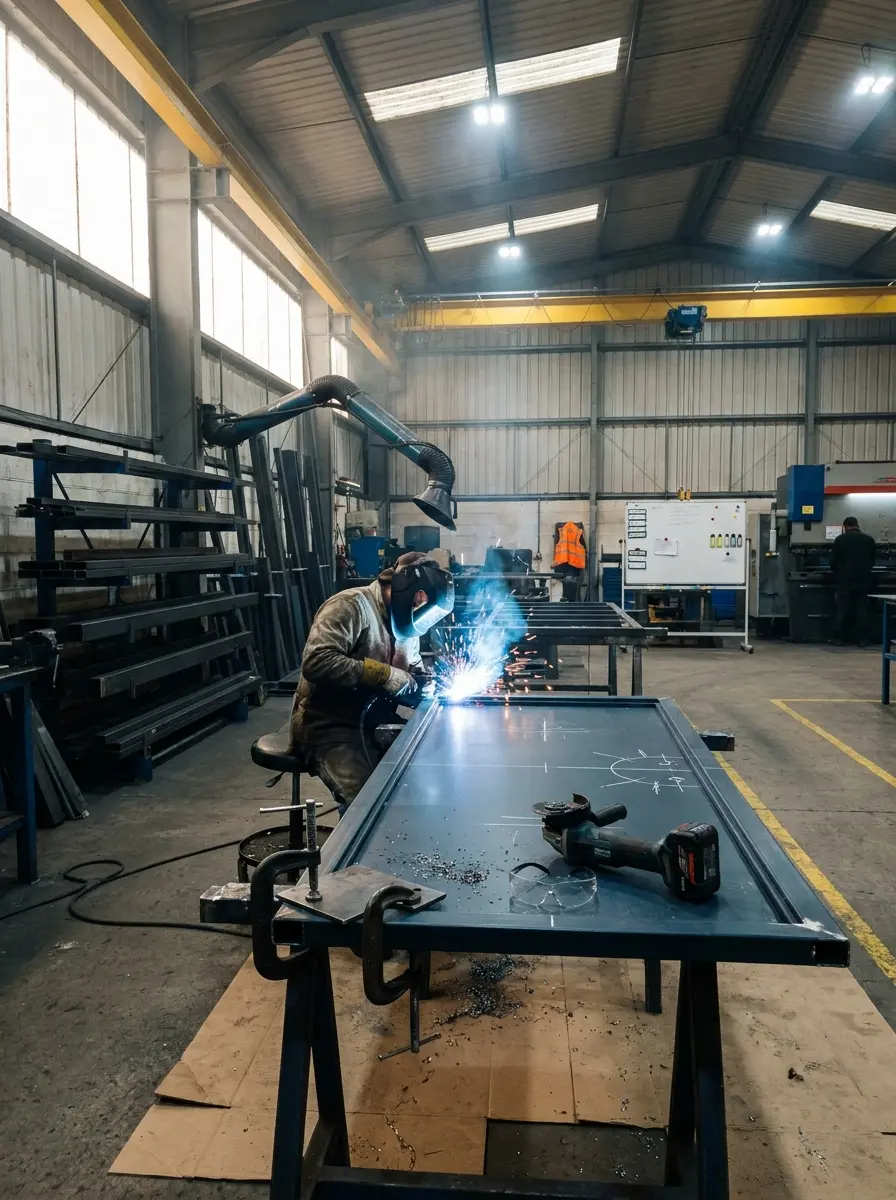
FE / FAC-01Factory floor, Luton. Mid-shift, mixed batch of SR3 and SR4 fabrications in progress.
Steel selection
Everything starts with the steel. For SR4 we use a specific grade and thickness combination – not because the standard mandates it (LPS 1175 is performance-based, not prescriptive) but because we’ve tested enough configurations to know what holds and what doesn’t. The leaf is built from steel plate. The frame is heavier section steel. Both arrive on pallets, mill certificates attached.
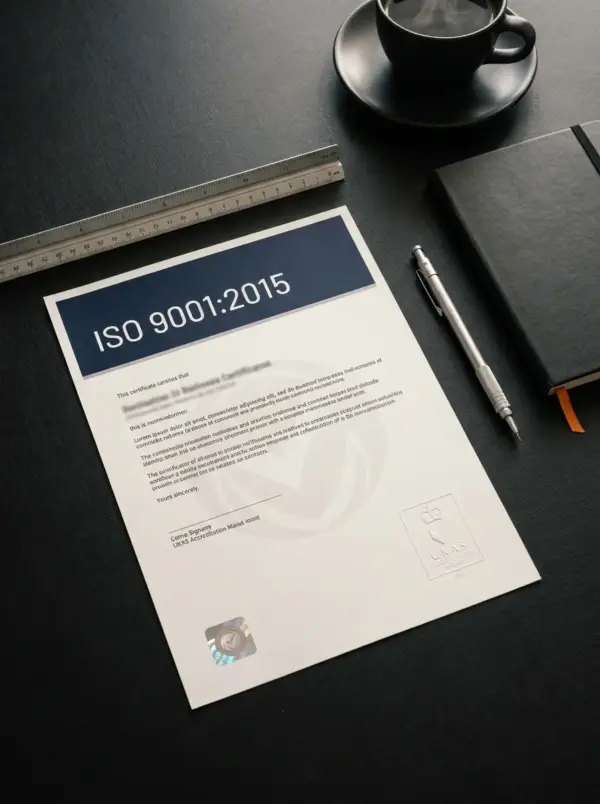
Each batch gets logged. Mill cert number, dimensions, delivery date, supplier. That log lives in our quality management system – the same one ISO 9001 audits against. If the LPCB auditor walks in tomorrow and asks “show me the steel certificate for the batch that built the doors on the Manchester contract last August,” we can find it in under a minute. That sounds bureaucratic. It is. It’s also the difference between a real manufacturer and a re-seller of imported product.
Cutting and forming
Plate goes to the laser cutter first. Modern fibre laser, programmed from CAD – the same CAD blocks we publish on the architect resources page. Cuts are clean enough that subsequent operations don’t need to true the edges. Frame sections go to the press brake, where they’re folded to spec.
Tolerances are tight. An SR4 door has to seat flush in its frame all the way around the perimeter. A 2mm gap at the top of the frame becomes a 2mm crowbar entry point at 8 minutes into an attack test, and the test fails. So tolerances aren’t a preference – they’re a hard requirement that the build has to hit every time, not just on the test specimen.
FE / FAC-02Press brake. The frame’s structural strength comes from the fold, not from welded gussets.
Welding the frame
Welders run MIG on the frame corners and the reinforcement plates that sit behind the lock and hinge positions. These reinforcements are what stops the lock case being levered out of the leaf during attack. They’re not optional. They’re not value-engineerable. They’re the second-biggest reason an SR4 door is heavier than the one that came before it.
Each welder has their own stamp. Their stamp goes on the door, and the welder’s number is recorded against the build sheet. If a door ever has an issue – cracked weld, misalignment, anything – we know who did the work and when. That’s not for blame. It’s for traceability. Welders who consistently produce clean work get reviewed differently from welders who don’t, and the standard improves over time because of it.
A note on weld penetration
Penetration depth matters more than weld appearance. A cosmetic-looking weld with shallow penetration will fail under attack faster than an ugly weld that’s bitten properly into the parent metal. Welders here know this. Architects sometimes don’t, and ask why the welds look “rough.” The answer is: because they’re real.
Hardware install
Once the frame and leaf are welded and dressed, hardware goes in. For SR4 this is at minimum: a high-security mortice lock case with a hardened bolt, anti-snap cylinder, security hinges with hinge bolts on the hanging side, and reinforcing plates around every point where a tool might be inserted.
The lock case has its own LPCB certificate. Most people don’t realise the door’s overall certification depends on the hardware being LPCB-certified separately – if we swap to a different lock, the door’s certification doesn’t transfer. So we don’t swap. The hardware spec sheet for an SR4 build is a controlled document. Changes require a re-test.
Finishing and paint
Doors go through grit-blast, then zinc-phosphate primer, then powder coat. Two coats, oven-cured at temperature. Standard finish is RAL black or an architectural standard colour. Bespoke colours are available but require a longer lead time because the powder has to be ordered against the spec.
The finish isn’t just cosmetic – it’s also corrosion protection. An SR4 door has to last in service for 15-20 years minimum. A door that rusts at the threshold in year three is a failure, even if it’d still pass an attack test on day one.
QA and audit trail
Every door gets inspected at hold points – typically four during the build and one at completion. Hold points are non-negotiable. Production doesn’t progress past them without sign-off. The sign-off goes on the build sheet that travels with the door.
When the LPCB auditor visits – which happens unannounced, several times a year – they pick doors at random from the production schedule and ask to see the build sheets. Mismatch between what’s signed off on the sheet and what’s on the door is a finding. Findings cost the certification if they’re not closed within 90 days. Nobody on the floor wants a finding.
Why this matters
LPCB certification isn’t a one-off test pass. It’s a continuous audit of the factory’s ability to reproduce the tested product every time. The test specimen and the door that ships on a Friday afternoon have to be functionally identical.
Dispatch
Finished doors get wrapped, labelled with the project reference, and stacked on the dispatch bay. The project reference ties back to the customer brand’s order – usually Fort Security Doors for B2B commercial work, or one of the other brands for sector-specific projects. We don’t ship to end clients directly. The customer brand does the install and the handover.
A typical SR4 door, from steel arrival to dispatch-ready, takes roughly 3-4 weeks. Most of that time isn’t fabrication – it’s the QA and the curing steps between operations. The actual hands-on metalwork is maybe 8-10 hours per door across all the operations combined. The rest is the system that makes sure the door we ship matches the door LPCB certified.
That system is what we sell. The door is just the output.